Welcome back to our Teaching and Learning in Focus (#TLF) Blog.
We hope that you are settling nicely into the semester thus far. By now, any registration and course access kinks should be ironed out for both you and your students. In our previous blog posts, we explored the following:
As you prepare to transition into the mid-term assessment phase of the semester, and bridge the gap between instruction and assessments, we would like to explore six laws of learning. This may assist you in designing your learning activities and assessment items and aligning them to your learning outcomes for more learner-centred lesson planning and delivery.
A – The Six Laws of Learning
Educational researchers and psychologists such as Edward Thorndike (1930), have identified six laws or principles that describe how people acquire and process new knowledge. To maximize retention, many educational psychologists postulate that the learner must be prepared/equipped, practice repeatedly, feel satisfied by the learning experience, grasp initial concepts well, engage deeply, and review recently learned material. Applying the following laws in your teaching context may assist you in designing/planning and delivering your instruction for students’ learning to be maximized.
B – The First Three Laws of Learning: Readiness, Exercise and Effect
The first three laws of learning were developed by notable educational psychologist, Edward Thorndike (1930), which he deemed as universally acceptable. Thorndike also postulated that learning is most effective when the learner is motivated, practices, and receives positive reinforcement, and his laws of learning help to achieve this:
The Law of Readiness: This refers to preparation, whereby educators are prepared to navigate through a lesson, and students are mentally, physically and otherwise prepared for learning (Ni & Lu, 2020; Irwan, 2016). It postulates that the basic needs of students must be satisfied if learning is to be maximized. To this end, students must have sufficient rest, a balanced diet and be physically active to learn effectively. It also states that stress, crowded schedules and unresolved issues/conflicts may be distracting or cause little interest in learning.
The Law of Exercise: deep-level learning is action-based. Activities that allow for recalling, summarizing or applying principles/theories (with repetition) ensure that the knowledge and learning experiences do not just remain in temporary/working memory, but are retained much longer e.g. learning to ride a bicycle.
The Law of Effect: Refers to the necessity for learning to be fun. Learning is stronger (i.e. the student retains more) when the learning experience is enjoyable. This also promotes students’ continuous learning (Ni & Lu, 2020)
C – The Additional Laws of Learning: Primacy to Recency
Since its introduction, Thorndike’s laws of learning have been further expounded with three additional laws:
The Law of Primacy: Mandates that the lesson must be designed and presented in a logical order. Learning and unlearning and relearning are quite difficult for the average learner to do and for the human mind to process. Having a carefully crafter lesson plan ensures that the topic is presented logically and correctly the first time it is taught.
The Law of Intensity: The more intense or impactful a lesson is taught, the more likely it will be retained by students. This principle implies that students will learn more from hands-on, sensory or authentic approaches (e.g. personal experiences, role-play, peer teaching).
The Law of Recency: Items most recently learned or practiced are best remembered. This principle suggests that the final, most recent information presented in a lesson is the most easily recalled. By contrast, the longer a learner is distanced from a new learning experience or information (knowledge), the more difficult it is for him/her to remember.
D – Applying the Laws of Learning – Implications for Teaching and Learning
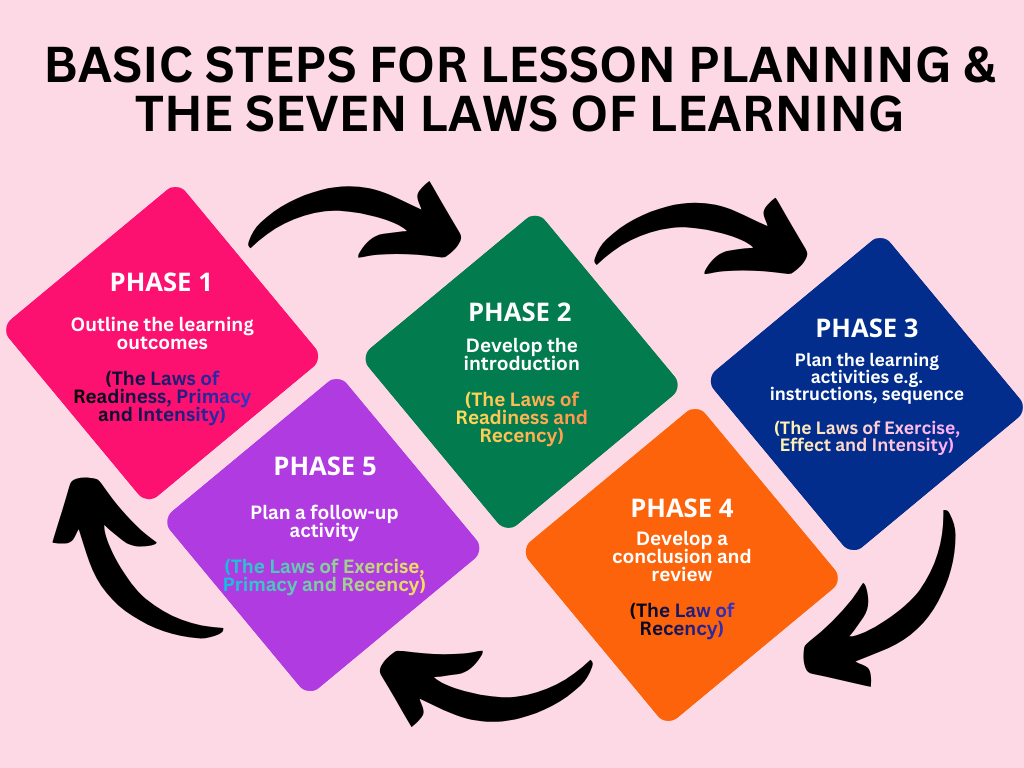
The laws of learning can easily be satisfied by lesson planning. Whether you are using ADDIE, ASSURE or other instructional design models, lesson planning involves the systematic process of outlining the specific learning objectives, instructional strategies, materials, and assessment methods for a particular class. Much like a roadmap, it helps educational practitioners to structure content and ensure learners achieve specific, measurable outcomes. Lesson planning involves preparing a detailed guide for teaching, adapting to student needs, and ensuring alignment with educational standards. Whatever instructional design model you may use, here are the general easy steps in lesson planning:
Here are some additional tips you may also consider:
Summary Sessions: The end of a lesson should be used to reiterate key points, as this is the "peak" time for the recency effect.
Frequent Review: To increase retention, frequent review of material is essential, especially the information covered last (i.e. the laws of exercise and effect).
Lesson Structure: Structure lessons to place crucial information at the very beginning (primacy) or the very end (recency) (i.e. the law of readiness).
Short Learning Sessions: Keeping learning episodes short helps maximize the number of "ends" in a learning, thus increasing the impact of the recency effect (i.e. the laws of primacy, exercise, effect and recency).
We hope the aforementioned tips and resources are helpful to you.
Should you need any further assistance, please feel free to contact us.