Educational research, otherwise known as the Scholarship of Teaching and Learning (SoTL) is the evidence-based, systematic investigation of teaching practices and student learning, primarily within higher education contexts. SoTL involves critical reflection (or reflective practice), evidence gathering (e.g. data collection), and public dissemination of findings to improve educational outcomes and thus contribute to a broader pedagogical knowledge base and improve teaching and learning practices (Bunnell et al, 2022). More specifically, SoTL is an impactful avenue for faculty to facilitate meaningful learning for students, and as an effective instrument that promotes the creation, implementation and evaluation of pedagogical innovations (Burns, 2017; Franzese & Felten, 2017).
| |
|
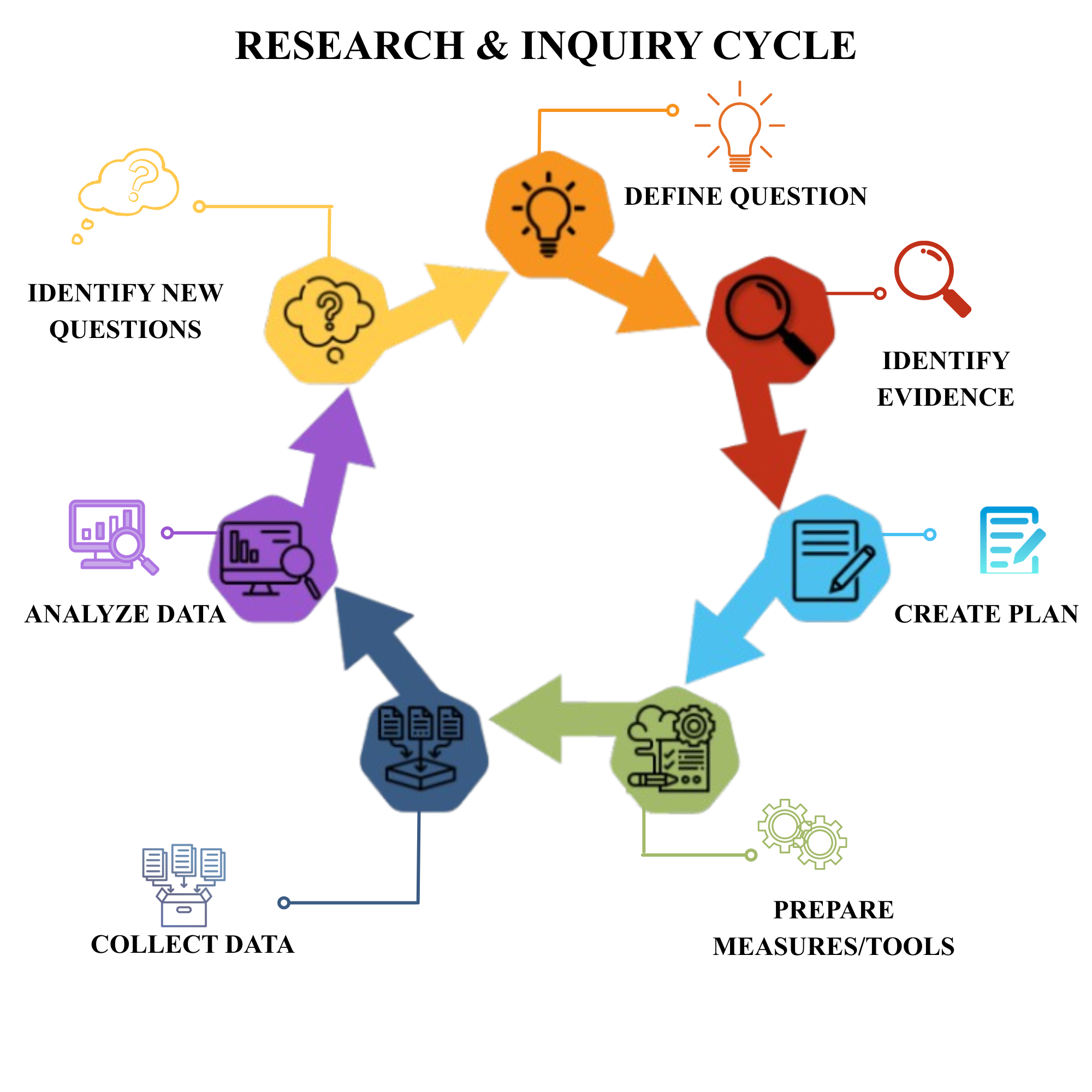
As seen in the following illustration (right), SoTL is sometimes conceptualized as a cycle of inquiry, as it requires:
- Definition of research questions,
- Identification of evidence and methods to answer the questions,
- Creation of an action plan,
- Preparation of tools, instruments and measures,
- Collection of data,
- Analysis of data,
- Identification of new questions.
|
 |
|
|
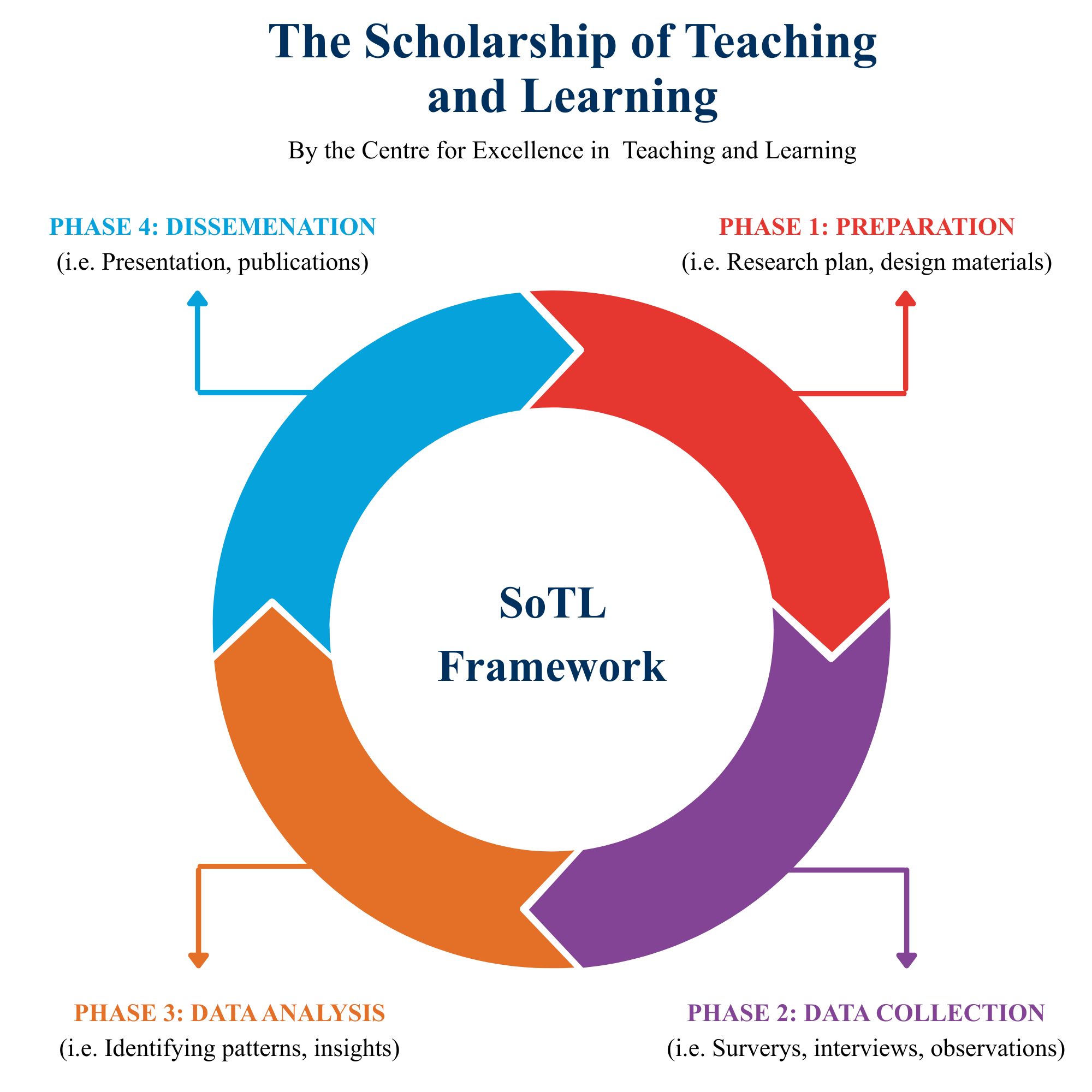
When applied, the aforementioned steps can be condensed into four phases. As seen in the illustration (on the right), these steps or phases are as follows:
- Phase 1: Preparation: Research, plan, design materials/instruments, pilot
- Phase 2: Data Collection
- Phase 3: Data Analysis (i.e. data cleaning, identifying patterns and phenomena, lessons learned)
- Phase 4: Revision (i.e. actioning data-driven changes to instruction)
|
 |
| |
|
|
|
Core Aspects and Characteristics of SoTL
SoTL comprises three primary components that ensures its relevance and impact in teaching and learning excellence. As seen in the following illustration, these are inter-related tenets include systematic inquiry, purpose and context.
Systematic inquiry transcends beyond just reflecting on one’s teaching practice (reflective practice). Moreover, it uses established research methods and designs such as data driven observations, literature reviews, as well as the assessment of learning outcomes.
Purpose refers to the primary goal of SoTL, which is to enhance teaching practices and student learning experiences, advocate for innovation in learning contexts, and share findings with the wider community of educational practitioners and stakeholders.
Context is another primary pilar of SoTL that focuses on discipline-specific pedagogical knowledge, where the educational research and its’ findings and impact are within the context of a specific discipline.
The Role of SoTL in Academia
Originating from Ernest Boyer’s 1990 work, "Scholarship Reconsidered", SoTL elevates teaching to the same level the same level of academic importance as traditional research. It supports a culture where educational practitioners investigate their own teaching to make evidence-based improvements, often in partnership with students (Felten, 2013). To that end, it may adopt more of an action research approach by using classroom or course data (e.g. assessment scores, feedback surveys etc) to test new strategies or for improvement of courses and programmes (Jacobsen, 2018). To this end, SoTL initiatives continue to gain institutional support as these are seen as highly valuable research and academic practices with considerable transformative potential to enhance teaching and learning experiences (Malfroy & Willis, 2018; Vithal, 2018).
References:
Boyer E. (1990)
Scholarship reconsidered: Priorities of the professoriate. The Carnegie Foundation for the Advancement of Teaching. Jossey-Bass.
Bunnell SL, Felten P, Matthews KE (2022). Toward trust in SoTL: The role of relational ethics. In: L. M. Fedoruk (Ed.),
Ethics and the Scholarship of Teaching and Learning. Ethics and Integrity in Educational Contexts, Springer, 2: 129–146
Burns, K. A. (2017). Community College Faculty as Pedagogical Innovators: How the Scholarship of Teaching and Learning (SoTL) Stimulates Innovation in the Classroom.
Community College Journal of Research and Practice, 41(3), 153–167.
https://doi.org/10.1080/10668926.2016.1168327
Felten, Peter (2013). "Principles of Good Practice in SoTL".
Teaching and Learning Inquiry: The ISSOTL Journal. 1 (1): 121–125. doi:10.20343/teachlearninqu.1.1.121
Franzese, Alexis T. and Felten, Peter (2017) "Reflecting on Reflecting: Scholarship of Teaching and Learning as a Tool to Evaluate Contemplative Pedagogies,"
International Journal for the Scholarship of Teaching & Learning: Vol. 11: No. 1, Article 8.
https://doi.org/10.20429/ijsotl.2017.110108
Jacobsen, D. M., Eaton, S. E., Brown, B., Simmons, M., & McDermott, M. (2018). Action research for graduate program improvements: A response to curriculum mapping and review.
Canadian Journal of Higher Education, 48(1), 82–98. Retrieved from
http://journals.sfu.ca/cjhe/index.php/cjhe/article/view/188048
Malfroy, J., & Willis, K. (2018). The role of institutional learning and teaching grants in developing academic capacity to engage successfully in the scholarship of teaching and learning.
International Journal for Academic Development, 23(3), 244–255.
https://doi.org/10.1080/1360144X.2018.1462188
Vithal, R. (2018). Growing a scholarship of teaching and learning institutionally.
Studies in Higher Education, 43(3), 468–483.
https://doi.org/10.1080/03075079.2016.1180350