
Welcome back to our Teaching and Learning in Focus (#TLF) Blog.
With just about a month into the semester, we hope all initial hiccups in your course have been resolved as you continue to navigate through the semester with excellence in teaching and learning. The transitions from face-to-face to blended or online modes of delivery require several adjustments by all stakeholders e.g. educators, learners, and administrators. In an online or blended learning context for example, students encounter many challenges regarding their engagement caused by the absence of physical contact and social interaction. This may be further compounded by an increasing number of distractions from other media such as television shows, network disruptions, device notifications and applications, competing for their attention. Even in a face-to-face learning context, these distractions may still exist via mobile devices for example. In extreme cases, a lack of engagement may also result in contentious and/or disruptive class behaviours and poor academic performance as learning is hindered. It is therefore important that you become cognizant and equipped with the avenues through which these circumstances can be mitigated and maximize engagement. A high level of engagement makes learning more impactful, increases retention and improves academic performance. It may also motivates learners in subsequent career pursuits.
In our previous blog post, we explored the concept and practice of active learning; well engagement may be defined as an active learning experience that requires learners to be attentive and not just in attendance. Ideally, this requires a high level of attention, commitment, and motivation from the learner. By taking an active/participatory approach to your instruction, you can help facilitate the students’ engagement and learning. Taking such an approach ensures that the student is more of an active participant and less of a passive recipient of knowledge. This of course, is applicable to a face-to-face, online or blended teaching and learning context.
Here are some tips you may consider to improve the level and quality of engagement in your teaching and learning context. These tips include simple practical strategies that can be applied throughout your course (plenaries, tutorial sessions etc):
1. Break The Ice – More than just an attention-grabber, an icebreaker is an activity that helps to set the tone of your synchronous and/or asynchronous course activities whether it is in a face-to-face, blended or online context. For example, you may create an activity that allows students to introduce themselves at the beginning of the course/session via an asynchronous discussion forum (in MyCaveHill eLearning) or in a synchronous discussion. Moreover, an icebreaker may function as a bridge-in to your lesson i.e. an activity that allows you to introduce or segue into the topic of your lesson. To this end, you may start the class/module via an introductory video, displaying statistics on a particular phenomenon, sharing a news report, or an excerpt from a movie or documentary.
2. Make it Infomal – According to research (Osborne & Dillon, 2007; Billett, 2024), learning is maximized in an informal context/setting. An informal approach may take the form of an open class discussion, story-telling, role-playing and may even include some form of comedy-relief or humour among you and your students. In addition to making learning more fun and increasing retention, such an approach allows students to feel comfortable, let their guards down, volunteer feedback, and may often help them learn without being aware of it.
3. Make it Collaborative – A collaborative approach allows students to work in teams on problems and projects under conditions that assure both positive interdependence and individual accountability. This active learning approach may take the form of Think-Pair-Share, Problem-Based, Inquiry-Based or Web-Quest activities. Such activities allow students to work together (in small groups) in brainstorming and exploring solutions to problems which they present or explain to their peers in the wider class. These activities may be synchronous or asynchronous in any mode of delivery. In an online context for example, you may consider using breakout rooms in Zoom where students can work in groups before sharing with the entire class. For the latter (asynchronous activities), you may consider using discussion fora which can be assigned to individual groups in MyCaveHill eLearning. Such a collaborative approach allows learners to develop social, communication and IT skills, which are facets of the distinctive UWI graduate, and assets in their subsequent careers.
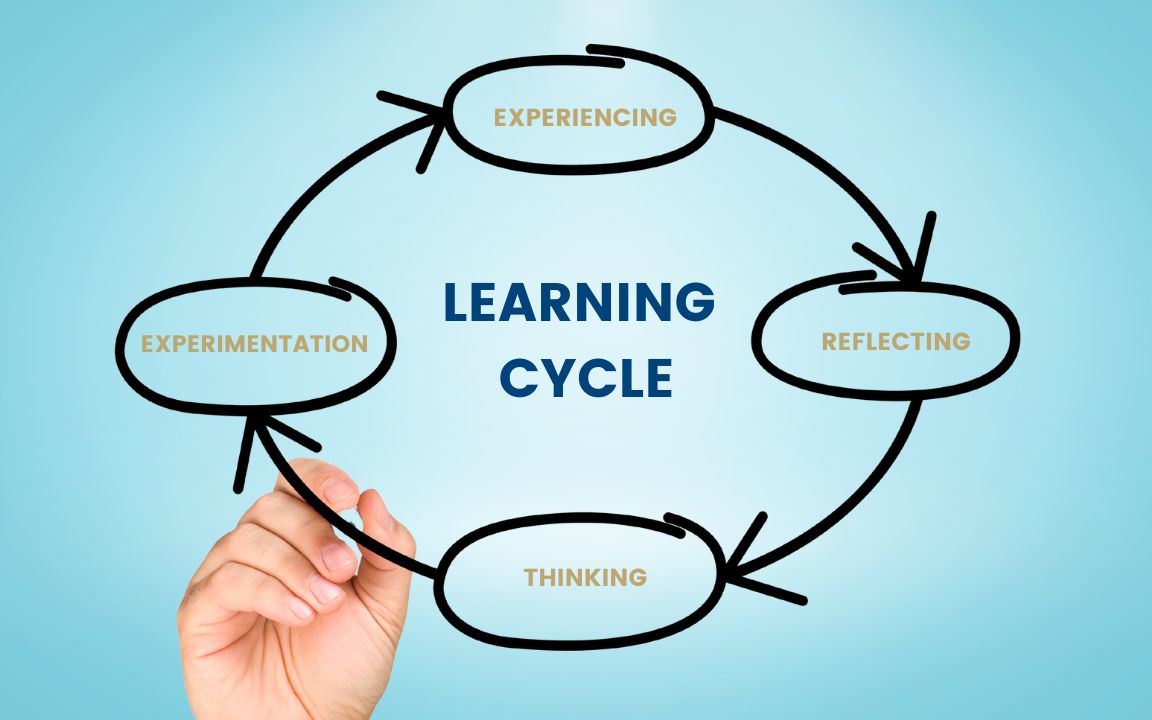
4. Make it Experiential – In its simplest form, this is learning by doing. More than just a hands-on approach to teaching and learning, this method takes students through a process of trial and error, critical thinking and discovery. An experiential approach may take different forms such as simulations, role-playing, and student demonstrations in a synchronous and/or asynchronous teaching and learning context in any mode of delivery. For example, you may instruct students to illustrate or demonstrate a simple chemical reaction, process or activity such as a musical arrangement, animal anatomy/physiology, landforms or simple soil erosion, which they can pre-record or illustrate/demonstrate live. Whatever form it may take, an experiential approach typically uses the following process: experience => reflection => conceptualization => experimentation.
5. Make it Relevent – Teaching and learning are closely affiliated with specific contexts. For this reason, the recency theory (Banez, 2016) and prior knowledge are fundamental in effective teaching and learning (Gee, 2012). For example, you or your learners may remember an event primarily because of the context (or circumstances) surrounding that event. Likewise, teaching and learning is context-specific even in a remote/online environment. To maximize engagement, try to use contemporary examples and materials where applicable. To this end, you may consider incorporating activities, case studies and materials that refer to the ongoing endemic. For example, you may instruct students to explore the impact of the ongoing endemic on the local or global economy or health sector, or the impact of recent natural disasters on the need for disaster preparedness in developing countries. Relevant materials and activities become more meaningful to students because they are already immersed in and/or can relate to the affiliated phenomena based on their prior knowledge or its recency. As such, it increases motivation and retention as well as participation and engagement among your learners.
We hope the aforementioned tips and resources are helpful.
Should you need any further assistance, please feel free to contact us.


