
Welcome back to our #TLF Blog. We hope that our previous posts have been helpful to you as you navigate through this contemporary teaching contexts. As the mid-term assessment phase of the semester comes to an end, we would like to explore assessments and its sometimes favourable, and other times questionable, relationship with artificial intelligence (AI). From course curricula/design, to the implementation of learning activities and creation of teaching and learning artifacts, the integration of AI in Higher Education has profoundly transformed the way things are done, created or managed. While many educators have been uncomfortable with the “threats” AI can create, some educators have begun to view AI in Education (AIEd) as less of a threat and more as a pedagogical instrument or resource as such tools provide real-time feedback and meet personal learning needs (Selwyn, 2021, and Luckin et al, 2016). But perhaps most notably, the revolutionizing impact of AIEd can be seen in the domain of educational assessments.
A – Assessments and The AI Factor
Retrieved from: https://www.zabala.eu/news/artificial-intelligence-and-consultancy/
The power of AI in educational assessments lies in the benefits it continues to provide. Responsible and ethical use of AI can assist in designing various formal (graded) or informal (ungraded) assessment activities, creating course curricula or lesson plans, and decoding large amounts of assessment data. For learners, it is often used as a guide that highlights various points or bits of information for consideration in answering questions or completing tasks. In such cases, AI is used as a resource. But while AI may provide a plethora of benefits, it is important that users are guided by ethical guidelines that ensure academic integrity, as failure to do so may result in AI becoming a threat to the aforementioned benefits it provides.
B – The Benefits and Challenges of AI in Assessments
When it comes to assessments, AI has certainly revolutionized how they are designed by educators and how they are done by students. The use of AI in educational assessments provides the following benefits:
But on the other hand, AI can also give way to a series of serious concerns or challenges. These include the following:
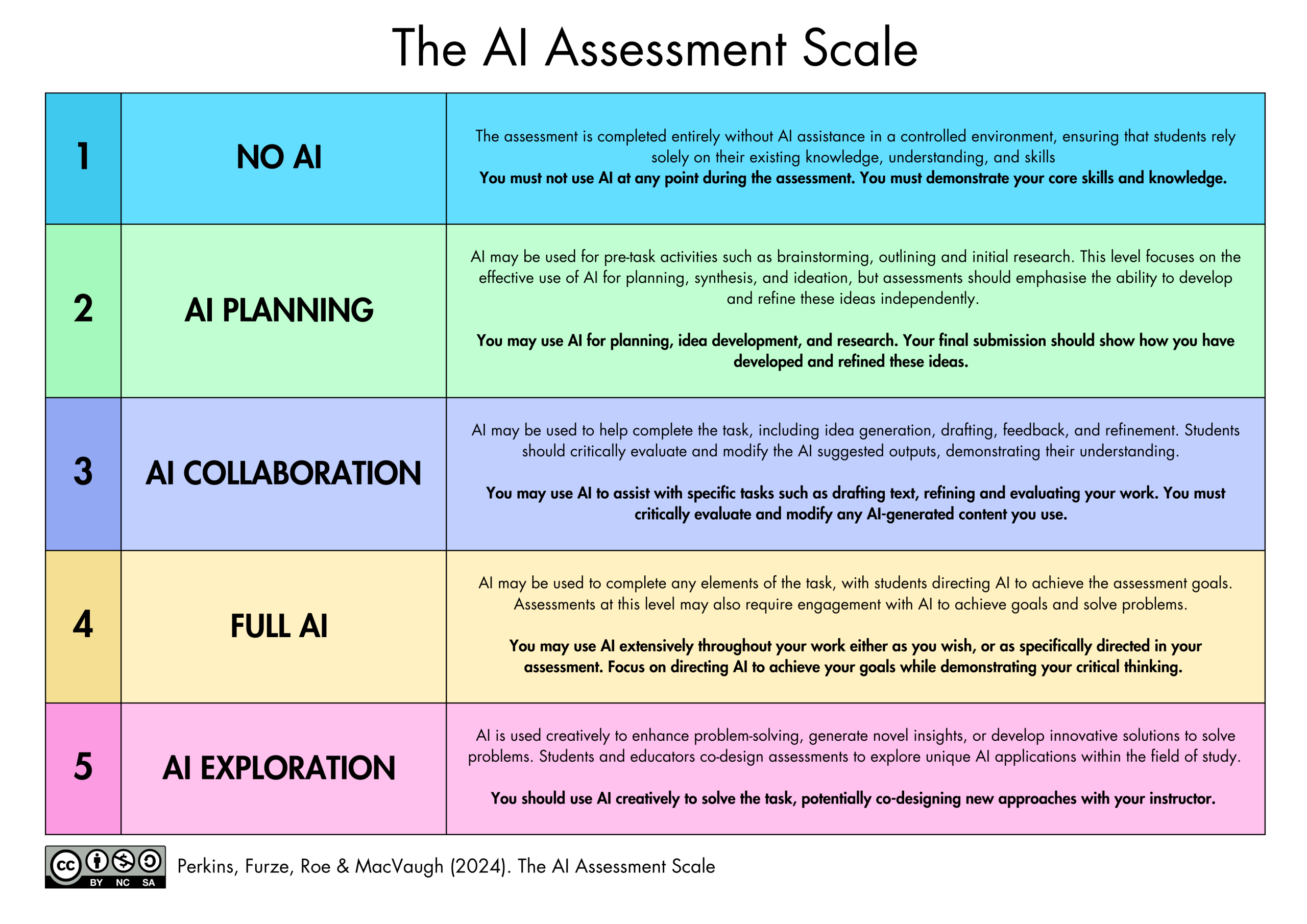
One thing we know, AI is here and it may be here for quite a while! The future of assessment is not without AI and its influence. Nevertheless, the future of AI should also focus on authentic assessments, which require students’ skills such as classroom presentations and discussions/debates, ethical reasoning, creative problem-solving (solving complex problems), that AI cannot replicate. To that end, it may be best for you to specify to students the extent to which AI can be used in a particular assessment. The aforementioned illustration provides a guide or scale in this regard. In your course assessments, try to include a balanced mix of AI integration and specific tasks (authentic components) where it is not required.
C – AI and Online Assessments
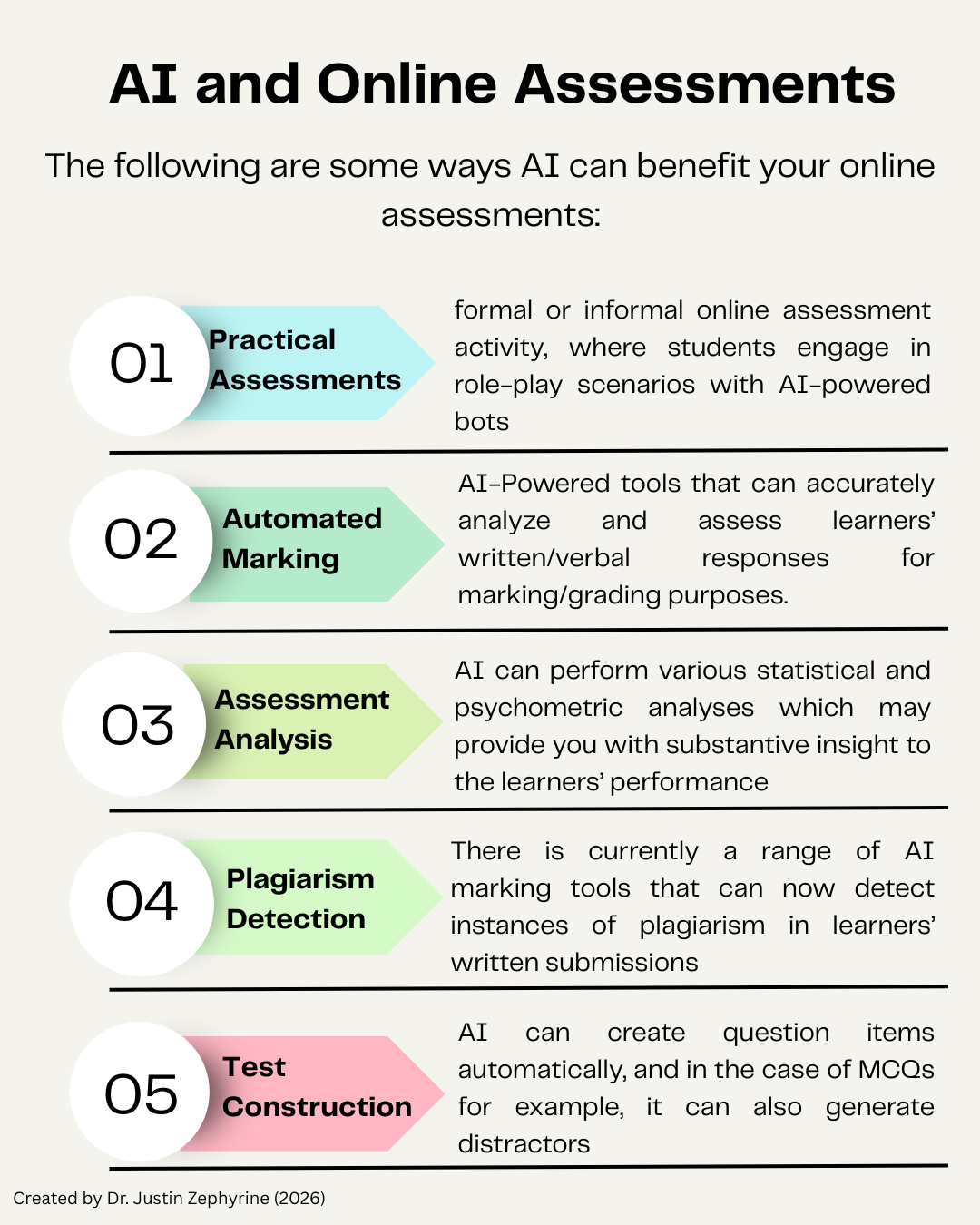
When it comes to online assessments, conventional avenues include lengthy essay questions, multiple choice quizzes, short-answer questions and the like. However, AI has vastly improved the ways in which online assessments are designed, delivered, marked/graded and more. Whether it is through automated item generation and marking, to personalized assessments and malpractice detection, AI continues to revolutionize the way we teach and asses, and the way students learn. The following are some ways in which AI can benefit your online assessments:
D – Additional Resources
We hope these points are useful to you. While AIEd can provide an array of benefits to teaching, learning and assessments, it still requires human input or intervention to ensure validity in your assessment items, and academic integrity in students’ assessment submissions. With continued developments in AI, it will continue to give birth to various innovations and transformations in teaching, learning and assessments. As such, the following is the UWI’s Official policy for Artificial Intelligence. It provides a much need framework for the integration of artificial intelligence into teaching, research, and operations while emphasizing ethics, equity, and academic integrity. Among other things, the policy mandates authorized AI use, and requires proper citation of AI-generated content (even in assessments) to avoid misconduct.
The following resources may help you in capitalizing on the power of AI in your assessments:
We hope the aforementioned tips and resources are helpful to you.
Should you need any further assistance, please feel free to contact us.


