

Welcome back to our Teaching and Learning in Focus (#TLF) Blog.
With just under a month into the semester, many of us are perhaps still settling into our courses along with most of our students, resolving issues with course access and registration. The CETL is happy to assist you in this process, with our offerings of webinars, workshops and other initiatives, including our #TLF blog site. In our previous blog post, we explored MyCaveHill eLearning Access and Support. This week, we want to take a closer look at #ActiveLearning
Active learning, sometimes called participatory learning, is a teaching method that allows learners to be actively involved in their learning experiences. An active learning approach encourages learners to critically think, deconstruct, assess, explore and create information. As such, it is a notable paradigm shift from the more traditional teacher-centred (passive learning) approach, as learners are given opportunities to create things, practice skills, solve problems, or synthesize and explain ideas in their own words. To this end, timely feedback plays a pivotal role, whether it is from an online interface or activity (e.g. a game or quiz), their peers or the course facilitator. Active learning promotes student engagement in learning activities, such as group discussions, role-play, or hands-on projects, that stimulate and develop the learners’ cognitive and sensory networks, thereby making the facilitator’s teaching and the learner’s learning more impactful. Educational research has consistently shown that the incorporation of active learning strategies into Higher Education courses substantively enhances the learning experiences for students (Freeman et al., 2014; Theobald et al., 2020).
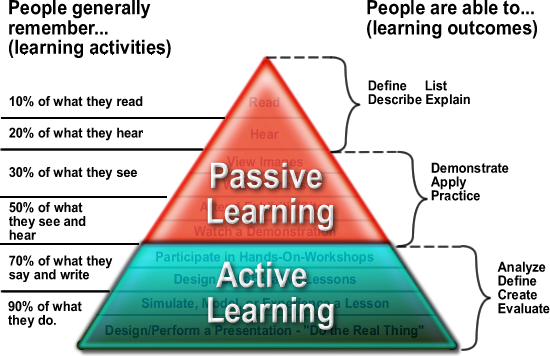
One of the good things about active learning is the many ways in which it can be easily implemented. It is by no means an absolute, “one-size-fits-all” approach but it is customizable to your various instructional contexts. You can be creative yet strategic in using active learning approaches and enriching the teaching and learning experiences for you and your learners. The following are some simple active learning strategies you may consider:
|
|
The aforementioned strategies are quite easy to implement and can be reused and/or repurposed to suit almost any instructional context. Moreover, these strategies reap substantive impacts/benefits especially for the learners. Perhaps one reason active learning is so heavily advocated in contemporary educational landscapes is due to the myriad of easily attainable benefits it provides. These benefits include:
Implementing an active learning approach is not an arbitrary phenomenon but is a systematic process. It requires careful lesson planning, ensuring that you align your learning outcomes with the appropriate learning activities and resources, and the sequence in which the different elements of the lesson will be executed. In an active learning approach, every activity, strategy or resource must take the student closer to accomplishing the learning outcomes (i.e. closer to learning the things they need to learn). This of course, requires instructional design principles and/or models, such as the ASSURE model, to be used. The following is an overview of active learning and brain-based instruction, and a very simple way in which these can be implemented (modelled by Professor Carl Wiseman, a Nobel Prize-winning Physicist who champions this approach).
In addition to the provision of course resources or materials (see last week’s blog post), activities provide a more engaging way to facilitate students’ assessments, interaction, and active learning needs. MyCaveHill eLearning activities refer to any task required by students usually for assessment or revision purposes. These activities may include quizzes, essays, projects, discussion fora, and even H5P activities. Whether students are required to answer a few questions, submit a document, or respond to a prompt or another student’s response, MyCaveHill eLearning activities positions students to become more actively involved in their learning experiences. For example, the workshop activity is a tool for creating interactive and collaborative learning experiences in your online/blended courses. This activity enables the collection, review and peer assessment of students’ work. By the end of the Workshop Activity, students obtain two grades – a grade for their submission and a grade for their assessment of their peers’ submissions. Both grades are recorded in the gradebook automatically.
Should you need assistance in using any activity in MyCaveHill eLearning, or in designing and implementing an active/participatory learning approach in your teaching context, the CETL will be happy help.
For additional immediate assistance with any technical issues, please reach out to campus IT via their support channels below:
The IT Service Desk
We hope the aforementioned resources are helpful.
Should you need any further assistance, please feel free to contact us.


