

Hello! Welcome back to our #TLF Blog. In our previous blog post, we explored the importance of feedback. Moreover, we focused on Turnitin, its feedback studio and AI detection capabilities. This week we want to build on that post/topic and take a closer look at formative assessments. We will also provide a few tips you may consider as you continue to navigate the mid-semester assessment phase.
A – What are Educational Assessments
More than just a single activity or item, educational assessments are the means through which learning is empirically measured. More specifically, educational assessments are systematic processes that facilitate the gathering, analyzing, and interpreting of information regarding a student's knowledge, skills, attitudes and any progress in their learning. Primarily used to improve teaching and learning, they identify academic strengths and/or gaps (areas for improvement) to inform instruction and measure achievement. Educational assessments may take several online or face-to-face forms such as quizzes and essays, and even more authentic context-specific avenues such as group or individual presentations, laboratory experiments, field work, group projects. and other proficiency-based tasks.
It is important to note, while educational assessments may help identify academic strengths and weaknesses, and may also guide instructional improvements, they are also useful in identifying possible learning disabilities. There are different types of assessments which include: diagnostic (pre-test), formative (ongoing/mid-term), and summative (final/end-of-semester) assessments. There is also a distinction between formal (graded) and informal (ungraded/learning activities) assessments.
B – The Primary Types of Educational Assessments
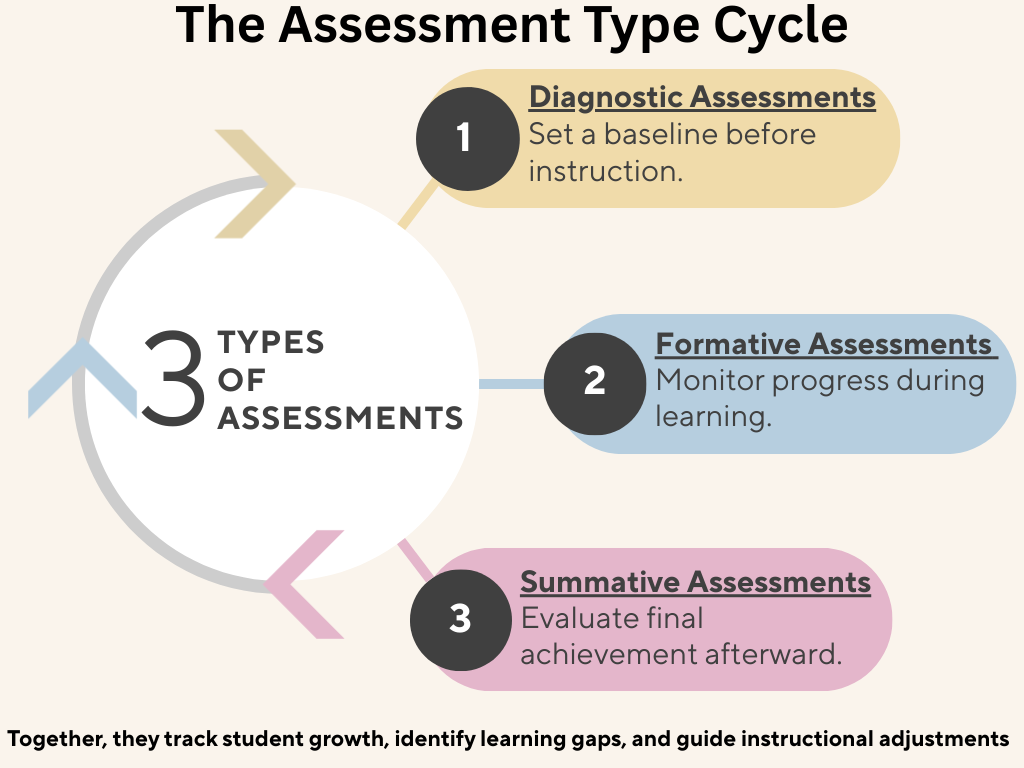
Although there are different types of assessments, such as norm-referenced and criterion-based assessments, which may vary based on the purpose, design and duration, there are three primary and inter-connected types of assessments that are most frequently used. As seen in the previous illustration, diagnostic, formative, and summative types of assessments form a continuous, 3-stage learning cycle: diagnostic sets a baseline before instruction, formative monitors progress during learning, and summative evaluates final achievement afterward. Together, they track student growth, identify learning gaps, and guide instructional adjustments.
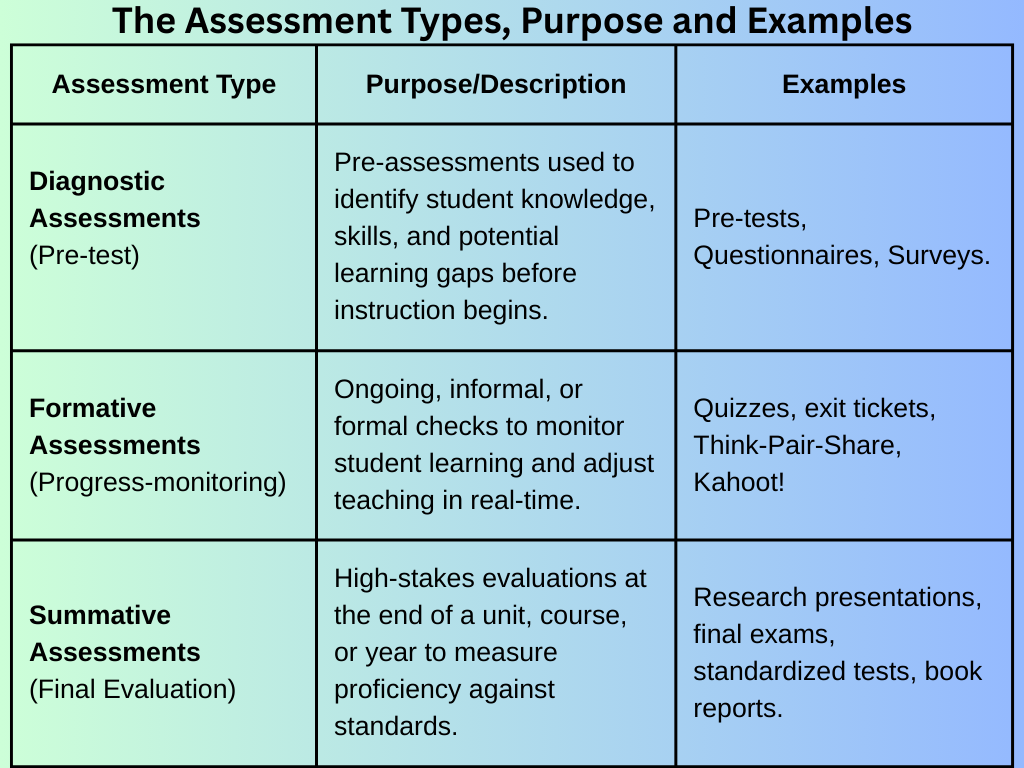
It is important to note that each type of assessment is designed for a specific time, purpose, use and medium in the learning experience. Here are a few more details about the primary types of assessments, including the ways in which each may be used:
C – Assessment For/As/Of Learning.
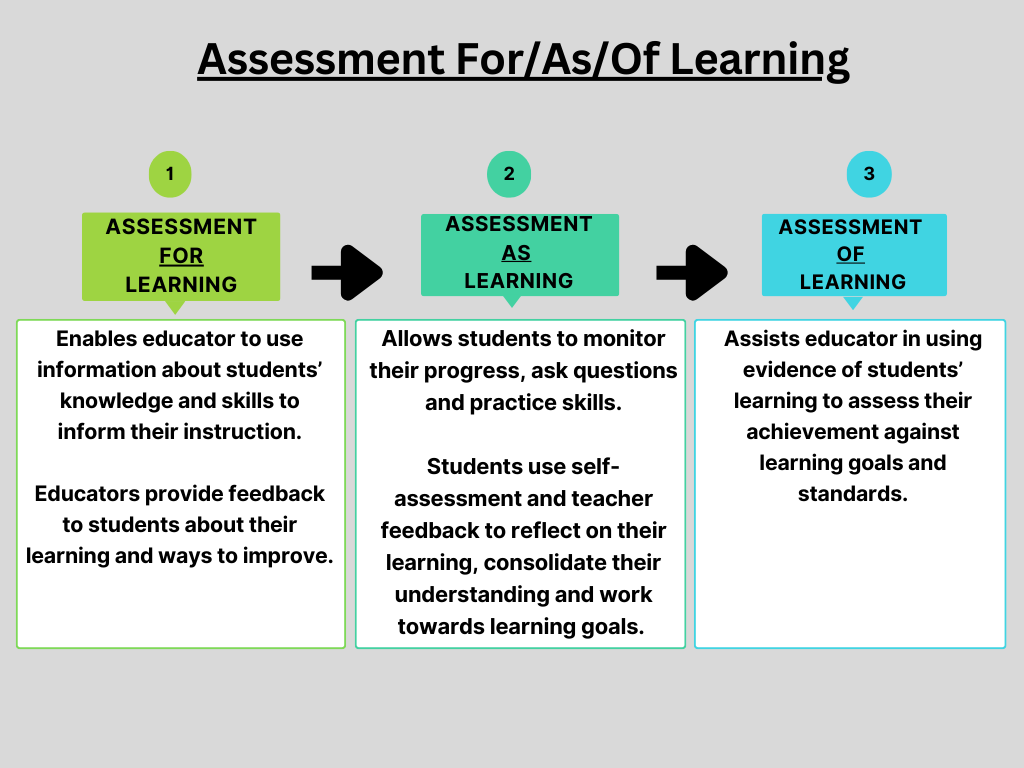
Assessments can be further distinguished almost solely based on learning. As seen in the following illustration, these learning-assessments are primarily identified as assessments FOR learning, assessment AS learning, and assessment OF learning. While assessment AS learning is formative (used to help students learn), assessment OF learning is usually summative (used for final grading). Assessment FOR learning is often for diagnostic purposes.
D – Educational Assessment Tips

The following are some simple tips you may consider as you implement these assessment types throughout your courses/teaching practice:
1. Use The Cycle/Three Assessment Types: Ideally, it is recommended that the three primary types of assessments are used throughout the different stages of the learning experience. This requires one (diagnostic) assessment at the beginning, at least 1-2 (formative) assessments during the, and if needed, one (summative) assessment at the end of the course/learning experience. This allows for a more thorough learning experience in any course you may be facilitating.
2. Ensure Constructive Alignment: It is also important to ensure that your assessments are relevant and well aligned with your learning outcomes. To that end, you may consider looking at one of our previous blog posts on Constructive Alignment: Connecting Learning Outcomes to Assessments.
3. Use a Variety of Assessments Methods: Also note, an assessment does not have to be paper-based (e.g. quiz or traditional exam), but it can be proficiency/skills-based (e.g. a field project, medical rotations, presentations or laboratory experiments), or learning activities such as games and class discussions or debates. But never under-estimate the simple questioning approach – ask questions while teaching. This not only enhances engagement but helps to verify that learning is taking place.
4. Provide Meaningful Feedback: Anytime a student has completed an assessment activity in your teaching context, your feedback is essential in helping them improve their knowledge, skills, attitudes to the field/course, and the overall teaching and learning experience. To that end, you may consider looking at one of our more recent blog posts on Feedback and AI Detection.
We hope the aforementioned tips and resources are helpful to you.
Should you need any further assistance, please feel free to contact us.


