

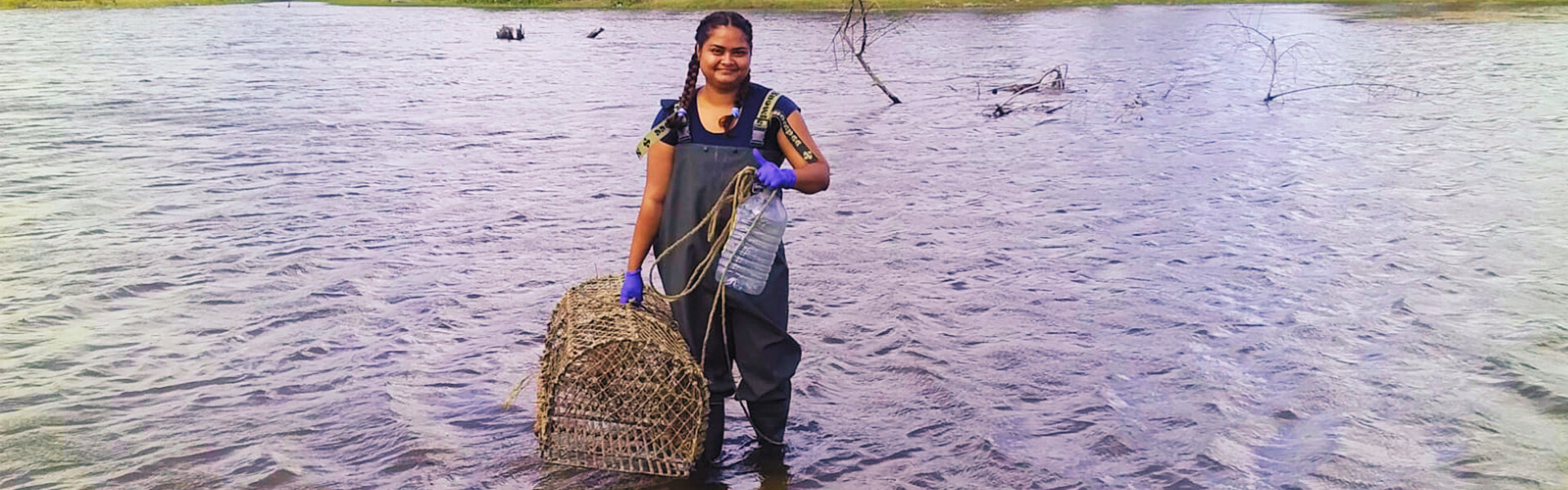
A childhood dream of becoming a conservation explorer is coming true for environmental scientist, Nadeshinie Parasram.
Growing up, she often watched National Geographic Explorer with her older brother, Kemraj Parasram, and would sometimes accompany him on his assignments.
“He was like, ‘ok, that’s what you want to do, I’ll take you with me’. So, he would take me along in the field so I could get some experience on sampling biodiversity,” she said of her sibling who is now the Executive Director of the Environmental Protection Agency in Guyana.
“[He] would make me watch National Geographic every time it showed on TV, because I was always so fascinated with how all those scientists … would tell you all about the ecology, the species, and their behavior; and I was very impressed with how they know all of this. So that is what got me interested in it, because I wanted to be like them.”
And so began her journey to becoming an environmental scientist. As a PhD student in The UWI, Cave Hill’s Department of Biological and Chemical Sciences, Parasram conducted research into Brachyuran crabs in Barbados. Last September, she successfully defended her thesis, “Cataloguing Biodiversity: The Brachyuran Crabs (Crustacea: Decapoda) of Barbados, West Indies”.
Hers was the first such study to be conducted in Barbados in over a century. The last comprehensive study on Brachyuran crabs in Barbados was from the Barbados-Antigua expedition of 1918, when researchers came to the island to collect samples around what was then Pelican Island over a three-day period. These samples were then taken to the Smithsonian National Museum of Natural History in the United States.
“[In] the last study that was done, they just focused on one area … and obviously, they didn’t have a lot of time to spend sampling every habitat. So, they did as much as they could and then they took the samples back to the US. So, local people didn’t even have that knowledge that they had, and they wrote their manuscript and published it,” she said.
For her study, Parasram sampled seven different habitat types across Barbados: rocky shores, mangrove forests, sandy shores, mud flat areas, freshwater streams, coastal clifftops, and coastal wetlands.
When she presented her work to the campus’s 60th Anniversary Graduate Research Symposium in March 2023, Parasram informed that the study was conducted in 27 different sample locations of the habitat areas using numerous trapping methodologies such as baited crab traps, hand nets, and fruit as bait.
Logging more than 400 search hours, she identified 58 species, 16 of which were reported in Barbados for the first time. The coastal wetland at Long Pond was also determined to be a hotspot for the crustaceans.
Highlighting the significance of her work, Parasram noted, “Our biodiversity is unique, but we remain underrepresented in global biodiversity studies because we don’t know a lot about Caribbean biodiversity. Everybody talks about biodiversity for other areas: North America, South America; but for the Caribbean, we are left alone. Recently, I attended a conference in Taiwan, and it really opened my eyes as to how underrepresented we are in terms of our Caribbean biodiversity.”
She aims to fill this gap by contributing knowledge and understanding of crustacean biodiversity in the Caribbean.
“[My study] focuses on biodiversity, taxonomy, and population genetics of crustaceans, and involves identifying, classifying and describing new species that are found in Barbados and the Caribbean in general. It basically seeks to uncover our rich diversity, the economic importance of each species, their genetic diversity, their population structure, and the evolutionary relationship. This could give a better understanding of their ecological roles within the terrestrial ecosystems and how this could benefit us as well, in terms of protecting our biodiversity from climate change.”
The study of crustaceans was not Parasram’s first choice. She began earlier research into marine flatworms under the guidance of now retired lecturer Dr. Angela Fields. However, nature intervened and she was forced to change.
“Before we started the project, which was in the summer of 2017, she took me to another field to do some preliminary sampling, and during this time we found many species of flatworm; they were all over and they were very easy to find. However, when the time came for me to start my project at the beginning of the semester and we went back to the field, we couldn’t find any flatworms; they just disappeared. And we tried for months but we couldn’t find any.
“Every habitat that we went to in Barbados, we just could not find any flatworms, but there were lots of crabs and crustaceans around. So, Dr. Fields suggested that I study crustaceans since they were very abundant in every habitat that we sampled.”
While she was not thrilled at the proposed change, Parasram eventually warmed to the idea.
“It was not until I really began to dive into the taxonomy of crustaceans that I became fascinated with how diverse this group is. I was particularly intrigued with the challenges of identifying and classifying species and understanding their evolutionary relationships, and also uncovering factors that influence their diversity, especially in our Caribbean region.”
Small island states, like those in the Caribbean, are most vulnerable to climate change, and Parasram noted that like all animals, crustaceans are critical for ensuring a resilience of species of ecosystems.
“They have ecological, economic, and scientific importance. My study contributes to the understanding of worlds of crustaceans in both terrestrial and marine ecosystems for Barbados and the Caribbean, and they’re important for commercial and artisanal fisheries in the Caribbean as well. I also identified species and habitats that are in need of protection and should be the focus of conservation efforts.”
Her research has so far been published in the peer-reviewed journal Zootaxa in 2021.
Her early dreams of one day becoming an explorer are becoming a reality, as she embarked this year on a three-month expedition in the French Antilles, from September to November.
“This is to sample the biodiversity of three remote islands off Guadeloupe, and it is in collaboration with the [National Museum of Natural History] in France. They reached out to me because of my work, and they asked me to join them, so it’s already happening,” Parasram said.


