

How Cave Hill Academics are Shaping Better Health Outcomes
September 18, 2026
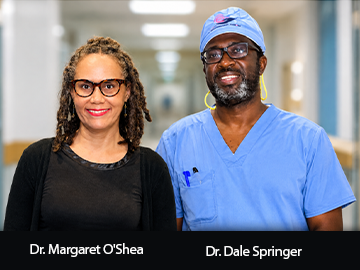
As Barbados and the wider Caribbean face the growing burden of chronic diseases, two academics at the Cave Hill Campus’ Faculty of Medical Sciences believe the key to better health outcomes lies in strengthening the connection between research, medical education and patient care.
Drs. Margaret O’Shea and Dale Springer, specialist surgeons at the Queen Elizabeth Hospital (QEH), point to recent advances in kidney transplantation and breast cancer treatment as evidence of what can be achieved when academia and clinical practice work hand in hand.
As a Consultant General and Renal Transplant Surgeon, Dr. O’Shea has played a pivotal role in strengthening Barbados’ kidney transplant programme. Building on the foundation established by Professor Emeritus Sir Errol Walrond, who performed the island’s first kidney transplant in 1987, she helped restart the living donor renal transplant programme at the QEH.
The programme has brought renewed hope to patients living with end-stage kidney disease, which affects an estimated 350 Barbadians and often requires long-term dialysis treatment.
Dr. O’Shea said the longstanding partnership between the Campus and the QEH has been critical to advancing healthcare in Barbados.
“It is important for the public to recognise the value the University has to the QEH. Teaching hospitals offer more evidence-based and up-to-date healthcare than non-teaching hospitals. The tremendous value of the University extends beyond hospital care and into healthcare in Barbados as a whole.”
Her contributions have extended beyond surgery. In 2026, she served on the advisory group that helped draft the Human Tissue Transplant Act, legislation that paved the way for a national deceased-donor programme and expanded access to life-saving transplantation.
Meanwhile, Consultant General and Breast Surgeon Dr. Springer has been helping to introduce innovative technologies and international best practices in breast cancer care. In June 2026, he co-led a QEH team in performing the Caribbean’s first surgeries using the SAVI SCOUT localisation system, which allows surgeons to precisely identify and remove breast abnormalities.
Dr. Springer said the milestone reflects the broader contribution of academic medicine to both patient care and public health.
“Not only do we teach residents and medical students, but they also engage with communities through health promotion activities, seminars and outreach initiatives that encourage healthier lifestyles and greater awareness,” he said.
The work of both doctors highlights the impact of the Faculty of Medical Sciences beyond the lecture theatre.


