

UWI scientist wins funding for sargassum-based plastic alternative
March 12, 2026
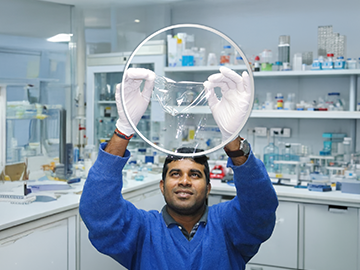
Dr. Srinivasa Popuri, Senior Lecturer in Analytical Chemistry in the Department of Biological and Chemical Sciences
What has long been seen as a frustrating invasion of Caribbean coastlines may soon become part of an exciting new environmental solution.
A research project at The University of the West Indies (UWI) Cave Hill Campus has secured international funding to transform sargassum seaweed into renewable bioplastic, opening the door to new possibilities for sustainable manufacturing in the region.
The initiative, From Marine Waste to Bioplastic: Sargassum-Derived Sodium Alginate for Sustainable Packaging and Plastic Alternatives, is led by Dr. Srinivasa Popuri, Senior Lecturer in Analytical Chemistry in the Department of Biological and Chemical Sciences.
The project has attracted support from the Plastic Waste Partnership under the Basel Convention, an international initiative established in 2019 with backing from the governments of Germany and Norway.
In a strong showing on the global stage, the Cave Hill proposal was ranked among the top ten out of 123 submissions worldwide and recommended for immediate implementation.
The research focuses on extracting sodium alginate from sargassum — a natural compound with remarkable versatility. Once processed, the material can be used to produce biodegradable packaging and serve as an environmentally friendly alternative to traditional plastics.
By converting the seaweed into a valuable raw material, the project aims to tackle two pressing issues facing the Caribbean: the growing challenge of plastic waste and the annual influx of sargassum along regional shorelines.
Sodium alginate is already widely used in industries across the world. It acts as a binding, thickening and gelling agent in products ranging from ice cream and jelly to cosmetics, dentistry materials, water treatment solutions and textile printing. With more than 150 applications, the compound presents exciting opportunities for sustainable innovation.
Dr. Popuri, who was notified of the award in January 2026, explained that the funding will allow his team to refine the extraction process to produce higher yields of the material while improving its quality and cost efficiency.
Researchers will also develop and test new biopolymer-based packaging products, assess how well they perform and how easily they biodegrade, and examine whether production can eventually be scaled within Barbados.
“This is not only a great achievement for me, but for the campus and the entire Caribbean region. We compete with the world, and even with limited resources, this proves there are no barriers to innovation,” Dr. Popuri said.
The next phase of the project will involve establishing a pilot plant to demonstrate the extraction process and test real-world applications. The facility will help pave the way for possible industrial use while linking the research to wider regional efforts to reduce plastic waste.
Collaboration will be central to the project, bringing together partners from academia, industry, government and civil society. Final-year undergraduate students will also be involved, gaining valuable hands-on experience while contributing to sustainability research.
The new funding adds momentum to a growing body of sargassum-focused research at Cave Hill. In December 2025, Dr. Popuri secured support from the Barbados Environmental Sustainability Fund to explore converting hydrogen sulphide gas from sargassum into bio-hydrogen — a potential source of clean energy.
Meanwhile, another Cave Hill initiative led by researcher Dr. Legena Henry is working to produce renewable natural gas from a mixture of sargassum, Blackbelly sheep manure and rum distillery wastewater.
Together, these efforts highlight how a persistent environmental challenge may be unlocking fresh opportunities for innovation, sustainability and economic development across the Caribbean.


