
Faculty of Science and Technology
The issues associated with remote work-life balance is even more apparent now because of COVID-19 and the strict quarantine all countries have enacted. Regardless of when vaccinations become widespread, there is significant additional stress associated with working from home whether they are under quarantine. Since this will not be the last such pandemic it is important that we reduce the stressors associated with remote work in the future.
A possible solution to this problem is the robotic avatar. As defined by the ANA Avatar XPRIZE, an avatar is a “system that can transport your senses, actions and presence to a remote location in real time and feel as if you’re actually there.” Some of the promising applications for avatar technology include providing disaster relief in dangerous places; avatar tourism; remote teaching and remote surgeries.
Creating avatars that meet the above definition requires specially built robots, and an interface system called a cockpit, which consists of haptic devices and a VR headset. The cockpit acts as a physical interface to the robot (the surrogate) that facilitates allow the “transportation” of the user’s senses to the remote world. These avatars are not for in-home or in-office use, which limits their deployment to large environments like mall stores or tourist destinations for example.
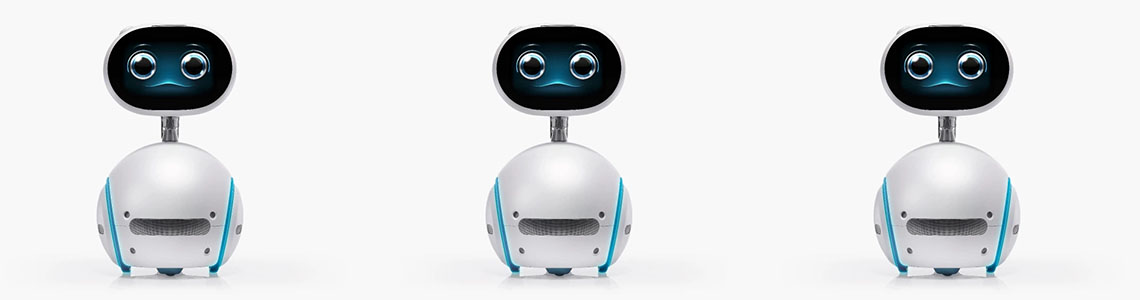
My project is to focus on the robot-as-a-surrogate in the human-robot relationship. While current robot avatar systems implement this relationship as a physical one, I intend to investigate the psycho-social aspects of the surrogate relationship. That is, I will use the robot as a psychosocial cognitive surrogate instead of a physical surrogate. I will achieve this by placing the Driven cognitive architecture, which I have been developing for modelling psychologically realistic virtual humans, into a low-cost Zenbo companion robot. The goal is to use the Driven cognitive architecture to capture psycho-social facets of the user and install them in the robot. Traits, like personality, as well as the user’s perceptions of their social relationships are the initial candidates for the focus of my research. The goal is, ultimately, that the robot will not only interact with other humans on behalf of its owner, but that it will behave like its owner.
C. Gittens, ‘Remote-HRI: A Pilot Study to Evaluate a Methodology for Performing HRI Research During the COVID-19 Pandemic’, in Proceedings of the 54th Hawaii International Conference on System Sciences, 2021, p. 1878.


