
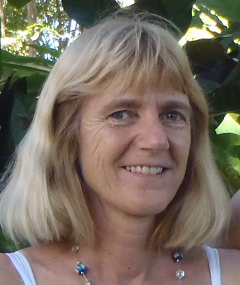
Hazel Oxenford earned her PhD in the biology and management of dolphinfish, Coryphaena hippurus, from UWI, Cave Hill in 1986. After a 6-month post-doc with McGill University working on other large pelagic fishery species of commercial importance to the Caribbean, she took up the position as main scientist on a 5-year IDRC-funded research project on Eastern Caribbean flyingfish. Subsequently she joined the staff at CERMES, UWI in 1991 to help develop and teach the first MSc programme in Natural Resource and Environmental Management at Cave Hill. She has remained on staff to this day and now has extensive Caribbean research, teaching and consulting experience, and wide experience in supervision of postgraduate students.
She serves on numerous national, regional and international committees, boards and working groups as an expert scientist. These include: Barbados Government appointed positions on the Fisheries Advisory Committee, the Working Group on Biodiversity, and the CITES Management Authority; regional CRFM-WECAFC scientific working groups on Recreational Fisheries, Flyingfish in the Eastern Caribbean, IUU Fishing, and Queen Conch; the Scientific Advisory Group for WECAFC-FAO; the international Fisheries Expert Group under the IUCN Commission on Ecosystem Management; and the Pool of Experts for the UN Regular Process for Gloabal Assessment of the state of the Marine Environment.
BSc Biology (University of Exeter, UK)
PhD (UWI, Cave Hill)
Hazel Oxenford is both a fisheries scientist and marine ecologist with special interests in fisheries biology, Caribbean coral reef ecology, and marine resource management in a changing world. She has published over 60 peer-reviewed papers, co-authored several books and book chapters, and more than 150 technical reports. She is the recipient of the Vice-Chancellor’s Award for Excellence (2012), and has received Campus Awards for the Most Internationally Successful Research (2015), Best Research Team (2015), Best Applied Research (2015). She has raised significant research funding and supervised 3 PhD and 5 MPhil students, as well as the research projects of more than 60 MSc students.
Oxenford, H.A. and I. Monnereau (2018). Chapter 9 Climate change impacts, vulnerabilities and adaptations: Western Central Atlantic marine fisheries. Pp. 147-168 in: Barange, M., Bahri, T., Beveridge, M., Cochrane, K., Funge-Smith, S., and Poulain, F. (eds.). Impacts of Climate Change on fisheries and aquaculture: Synthesis of current knowledge, adaptation and mitigation options. FAO Fisheries Technical Paper 627.
Vallès, H., and H.A. Oxenford (2018). Simple family-level parrotfish indicators are robust to survey method. Ecological Indicators 85: 244-252.
Gill, D.A., H.A. Oxenford, R.A. Turner and P. Schuhmann (2017). Making the most of data-poor small scale fisheries: low cost mapping of fishing activity. Marine Policy, https://doi.org/10.1016/j.marpol.2017.10.040
Oxenford, H.A., and H. Vallès (2016). Transient turbid water mass reduces temperature-induced coral bleaching and mortality in Barbados. PeerJ 4: e2118
Gill, D. P.W. Schuhmann and H.A. Oxenford (2015). Recreational diver preferences for reef fish attributes: economic implications of future change. Ecological Economics 111: 48-57
Aldana Aranda, D., H.A. Oxenford, C. Bissada, M. Enriquez, T. Brulé, G.A. Delgado, I. Martínez Morales and L. Frenkiel (2014). Reproductive patterns of queen conch, Strombus gigas (mollusca gastropoda) across the Wider Caribbean. Bulletin of Marine Science 90: 813-831
Valles, H. and H.A. Oxenford (2014). The utility of simple fish community metrics for evaluating the relative influence of fishing vs. other environmental drivers on Caribbean reef fish communities. Fish and Fisheries 16: 649-667
small scale fisheries, tropical fisheries biology, coral ecology, sargassum impacts, sargassum, CERMES,UWI,Cave Hill Campus


