
Research Projects
EBM-DSS : About Us
About Us
Background
Ecosystem-based management (EBM) is an approach that goes beyond examining single issues, species, or ecosystem functions in isolation. Instead it recognizes ecological systems for what they are: a rich mix of elements that interact with each other in important ways. Ecosystems provide valuable natural services, or “ecosystem services”, for human communities, therefore, to protect our long-term wellbeing we need to ensure that ecosystem functions and productivity are managed sustainably. This means managing them in a way that acknowledges the complexity of marine and coastal ecosystems, the connections among them, their links with land and freshwater, and how people interact with them.
Management must be integrated, just as ecosystems are interconnected. EBM aims to manage each of the human uses at a scale that encompasses its impacts on ecosystem function, rather than scales defined by jurisdictional boundaries. EBM involves two changes in how management is practiced: (1) each human activity is managed in the context of ALL the ways it interacts with marine and coastal ecosystems, and (2) multiple activities are being managed for a common outcome.
The practical application of EBM can be a challenging task given the complexities of ecosystems of interest. Utilising easy-to-apply operational methodologies can simplify EBM applications for decision makers and stakeholders involved (see Methodology & Software’ section). The application of EBM can become even easier to implement through the use of specifically-developed decision support systems (DSS) that are available as software packages (see Methodology & Software’ section).
Project Objective
The main objective is the adopting of more holistic approaches to the conservation and use of marine resources and ecosystems. Achieved through the building of capacity in the region, through provision of training to English speaking countries, and the establishment of UWI-CERMES as a regional node for the application of EBM.
Project Scope
English-speaking countries of the Wider Caribbean Region.
Ecosystem-based management (EBM) is an approach that goes beyond examining single issues, species, or ecosystem functions in isolation. Instead it recognizes ecological systems for what they are: a rich mix of elements that interact with each other in important ways. Ecosystems provide valuable natural services, or “ecosystem services”, for human communities, therefore, to protect our long-term wellbeing we need to ensure that ecosystem functions and productivity are managed sustainably. This means managing them in a way that acknowledges the complexity of marine and coastal ecosystems, the connections among them, their links with land and freshwater, and how people interact with them.
Management must be integrated, just as ecosystems are interconnected. EBM aims to manage each of the human uses at a scale that encompasses its impacts on ecosystem function, rather than scales defined by jurisdictional boundaries. EBM involves two changes in how management is practiced: (1) each human activity is managed in the context of ALL the ways it interacts with marine and coastal ecosystems, and (2) multiple activities are being managed for a common outcome.
The practical application of EBM can be a challenging task given the complexities of ecosystems of interest. Utilising easy-to-apply operational methodologies can simplify EBM applications for decision makers and stakeholders involved (see Methodology & Software’ section). The application of EBM can become even easier to implement through the use of specifically-developed decision support systems (DSS) that are available as software packages (see Methodology & Software’ section).
Project Objective
The main objective is the adopting of more holistic approaches to the conservation and use of marine resources and ecosystems. Achieved through the building of capacity in the region, through provision of training to English speaking countries, and the establishment of UWI-CERMES as a regional node for the application of EBM.
Project Scope
English-speaking countries of the Wider Caribbean Region.
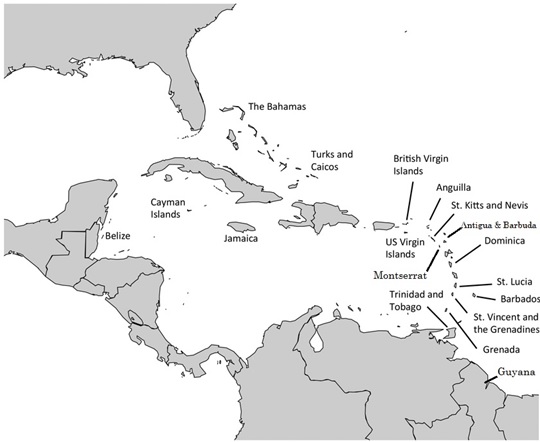
Anguilla Antigua & Barbuda • Bahamas • Barbados • Belize
British Virgin Islands • Cayman Islands • Dominica • Grenada • Guyana
Jamaica • Montserrat • St. Kitts & Nevis • St. Lucia • St. Vincent & the Grenadines
Trinidad & Tobago • Turks & Caicos • US Virgin Islands
British Virgin Islands • Cayman Islands • Dominica • Grenada • Guyana
Jamaica • Montserrat • St. Kitts & Nevis • St. Lucia • St. Vincent & the Grenadines
Trinidad & Tobago • Turks & Caicos • US Virgin Islands
Project Duration
September 5th, 2017 – April 30th, 2018
The Regional Node, established at UWI-CERMES is expected to persist after the end of the project.
Funding Agencies
Funding is being provided by the Government of Italy, Italian Agency for Cooperation and Development (IACD) and the United Nations Environment Programme - Caribbean Environment Programme (UN Environment-CEP).
Executing Agency
UNEP-CEP
UWI-CERMES EBM-DSS Team
September 5th, 2017 – April 30th, 2018
The Regional Node, established at UWI-CERMES is expected to persist after the end of the project.
Funding Agencies
Funding is being provided by the Government of Italy, Italian Agency for Cooperation and Development (IACD) and the United Nations Environment Programme - Caribbean Environment Programme (UN Environment-CEP).
Executing Agency
UNEP-CEP
UWI-CERMES EBM-DSS Team
| Expert | Thematic Expertise | Name | |
| Team Leader | • Strategic planning. • Planning and Management of complex spatial systems. |
Dr. Patrick McConney | patrick.mcconney@gmail.com |
| Data Analyst Ecological Analyst |
• Data collection and management protocols. • Design & Development of tabular and GIS databases. • Analysis of ecological systems. • Ecological connectivity. • Coastal-Marine Ecology. |
Dr. Julian Walcott | walcott.julian@gmail.com |
| Socio-Economic expert | • Analysis of economic activities. • Institutional governance. |
Ms. Maria Pena | maria.pena@cavehill.uwi.edu |
| Land Use, Water & Infrastructures Expert | • Land management. • Economic and social infrastructures (e.g. housing and urban areas, touristic infrastructures, seaport and marina, road network). • Water supply and waste water management. |
Dr. David Yawson | david.yawson@cavehill.uwi.edu |


