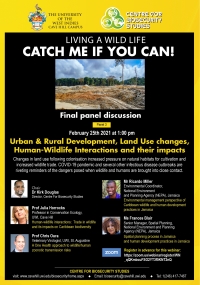
Early human activity in the Caribbean involved the clearing of forested areas for settlements and small scale agriculture, with exploitation of wildlife for food and products. Changes in land use following colonisation increased pressure on natural habitats for cultivation and increased wildlife trade. Urban areas have increased in size, and many coastal areas have been developed for tourism. These changes have displaced wildlife and increased the frequency of human-wildlife interactions. Under these circumstances, wildlife can become agricultural pests, occupational hazards (birds and aeroplanes), peri-domestic pests (bats, rats, mice, etc.) and introduced wildlife can become invasive alien species (IAS). The COVID-19 pandemic and several other infectious disease outbreaks are riveting reminders of the dangers to human health posed when wildlife and humans are brought into close contact. Caribbean biodiversity is a critical natural resource and provides irreplaceable ecological services, but it also poses risks for public health, food security, economic security and national security.
In the third and final Panel Discussion in the Living a Wildlife: Catch Me If You Can webinar series, the effects of the changes in land usage and its impacts on wildlife habitat is widely discussed. Attendees are treated to brief presentations from each panelist, comprising: Prof. Julia Horrocks, Senior Lecturer in Wildlife Ecology, UWI (Cave Hill); Mr. Ricardo Miller, National Environmental Protection Agency (NEPA), Jamaica; Prof. Chris Oura, Virologist, UWI (St. Augustine) and Ms. Frances Blair, Senior Manager, Spatial Planning, National Environmental Protection Agency (NEPA). Moderating the session was Dr. Kirk Douglas, Director, Centre for Biosecurity Studies.

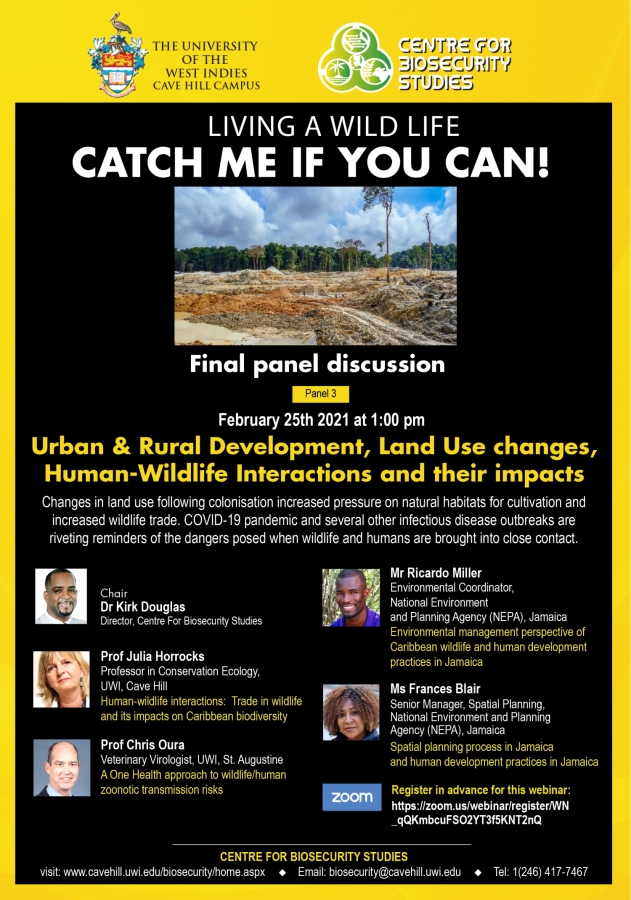 Early human activity in the Caribbean involved the clearing of forested areas for settlements and small scale agriculture, with exploitation of wildlife for food and products. Changes in land use following colonisation increased pressure on natural habitats for cultivation and increased wildlife trade. Urban areas have increased in size, and many coastal areas have been developed for tourism. These changes have displaced wildlife and increased the frequency of human-wildlife interactions. Under these circumstances, wildlife can become agricultural pests, occupational hazards (birds and aeroplanes), peri-domestic pests (bats, rats, mice, etc.) and introduced wildlife can become invasive alien species (IAS). The COVID-19 pandemic and several other infectious disease outbreaks are riveting reminders of the dangers to human health posed when wildlife and humans are brought into close contact. Caribbean biodiversity is a critical natural resource and provides irreplaceable ecological services, but it also poses risks for public health, food security, economic security and national security.


